
Global Cosmetic Chemicals Market Size by Product Type , Application , End-Use Segment, and Region - Segment-Level Market Assessment, Growth Opportunity Analysis, Competitive Mapping & Forecast to 2034
Overview
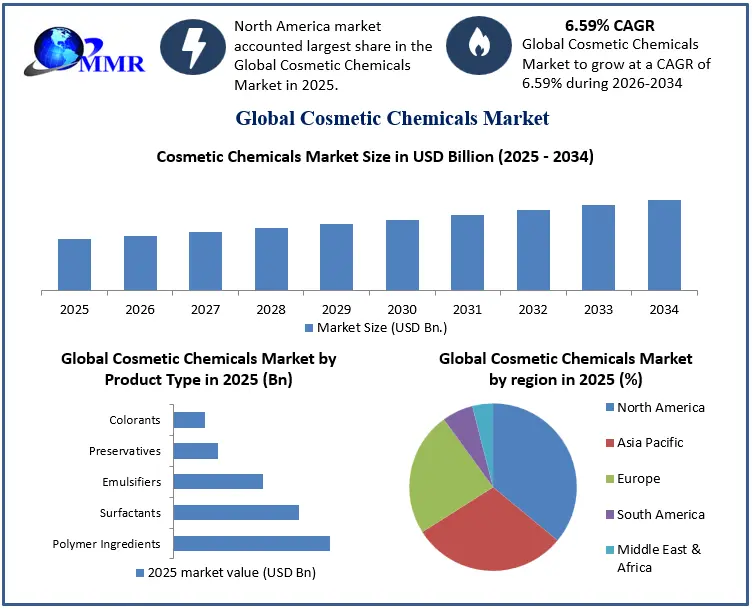
Global Cosmetic Chemicals Market valued at USD 21.55 Bn. in 2025, projected to reach USD 38.27 Bn. by 2034, growing at 6.59% CAGR.
Cosmetic Chemicals Market Overview
Cosmetic chemicals are specialized ingredients used in the formulation of personal care and beauty products such as skincare, haircare, makeup, and fragrances. These include emollients, surfactants, preservatives, colorants, and active agents.
The cosmetic chemicals market is rapidly driven by their increasing demand for advanced skincare, haircare, and personal grooming products. Rising consumer awareness about ingredient safety and preferences for natural and sustainable products are influencing both supply and availability.
North America holds a dominant position in the Cosmetic Chemicals market due to its high consumer expenditure on premium personal care products and continuous innovation. Asia Pacific is emerging as fastest fastest-growing region by their rising disposable incomes, urbanization, and booming beauty industry, mainly in countries like China, India, and South Korea.
Major Key players of the Cosmetic Chemicals Market, like Ashland, BASF, Croda International, and Evonik Industries, are leading the market by their strategic R&D investments, product innovation, and collaborations with top cosmetic brands. These companies are also focusing on developing eco-friendly and performance-enhancing ingredients.
In terms of end-user contribution, skincare and haircare applications account for the largest share due to their growing concerns about skin health, aging, and hair damage. Also, rising demand in segments like color cosmetics and fragrances reflects evolving beauty trends and lifestyle preferences.
The report also helps in understanding the Global Cosmetic Chemicals Market dynamics, structure by analyzing the market segments and projecting the Global market. Clear representation of competitive analysis of key players by Application, price, financial position, Product portfolio, growth strategies, and regional presence in the Global Cosmetic Chemicals Market makes the report an investor’s guide.
Cosmetic Chemicals Market Growth and Share Analysis
To know about the Research Methodology :- Request Free Sample Report
Cosmetic Chemicals Market Dynamics
Drivers – Growing Demand for High-Performance and Sustainable Ingredients:
The demand for skincare, haircare and personal-care products is on the rise. This growth is leading to an use of specialized cosmetic chemicals. Consumers are paying attention to what is in their products. They want high-quality ingredients. They prefer plant-based formulations. They also care about how the products work. This shift in consumer behavior is pushing manufacturers to focus on creating ingredients that perform well and are good, for the environment. Manufacturers are now investing in sustainable ingredients to meet these expectations.
Restraints – Growing Rules and Compliance Needs:
Strict rules about the safety of ingredients used in beauty products how products are labeled where the factories are registered and how product safety is proven are making it harder for companies to follow the rules. For instance according to the U.S. MoCRA system beauty businesses have to register with the FDA and people in charge have to list all the beauty products they sell. This adds paperwork and more responsibility, for companies.
Opportunities – Biotechnology and Innovative Ingredient Development:
Opportunities in biotechnology and innovative ingredient development are growing. Advances in biotechnology are helping to create cosmetic ingredients that work better and are more sustainable. Companies can use biotechnology along, with raw materials and ingredients that serve multiple purposes to make products that match what today’s consumers want. These new approaches also help to make the formulation process more efficient.
Challenges – Balancing Performance, Cost and Sustainability:
Cosmetic chemical manufacturers face the challenge of developing ingredients that are safe, effective, affordable, and environmentally friendly. Switching to sustainable alternatives can also require more research and testing while ensuring that the final product maintains the same quality and performance.
Cosmetic Chemicals Market Segment Analysis
Based on Product Type, the cosmetic chemicals market is segmented as surfactants, colorants, preservatives, emulsifiers, and polymer ingredients. In 2025, the polymer ingredient segment was dominant and held almost 35% of the overall market share in terms of revenue. Emollients, for example, are polymer compounds that soften the skin by reducing water loss. They're found in skin moisturizers, body lotions, lipsticks, and face creams, among other cosmetics and personal care products.
These emollients are available in both synthetic and natural versions on the market. Beeswax, Coconut oil, olive oil, lanolin, glycerin, petrolatum, zinc oxide, mineral oil, butyl stearate, and Di glycol laurate are some of the most often used emollients.
Based on Application, the cosmetic chemicals market is segmented as follows: skincare, haircare, oral care, fragrances, makeup, and others. In 2025, the skincare segment was dominant and held almost 40% of the overall market in terms of revenue. This is because of an increase in consumer demand for skincare products as people become more concerned about their skin's health and upkeep. The market for cosmetic chemicals is anticipated to benefit from rising demand for face creams, sunscreens, and body lotions around the globe.
The key causes driving the sale of hair care products are rising consumer worries about grey hair and hair loss, as well as changing hair styling trends in the fashion sector. Increased stress and pollution are key contributors to hair loss, discoloration, thinning, and dandruff in young and middle-aged people. This is also expected to increase the use of hair care products among them.
Cosmetic Chemicals Market Regional Analysis
Cosmetic Chemicals Market Competitive Landscape
Top players in the cosmetic chemicals market include Ashland, Lubrizol, IFF (International Flavors & Fragrances), and Sensient Technologies. Ashland prominent focus on sustainable, biofunctional ingredients and continuous R&D in biodegradable polymers, expanding its facility in Ireland. Lubrizol invests heavily in polymer science and multifunctional cosmetic ingredients, offering innovative solutions for skin protection and enhanced sensory feel.
IFF leverages advanced biosciences and AI-driven formulation, backed by over $500 million in annual R&D, mainly after merging with DuPont’s Nutrition & Biosciences. Sensient Technologies leads in natural colorants and clean beauty ingredients, supported by advanced pigment and botanical extract research. These companies are top players due to their strong innovation pipelines, global presence, strategic acquisitions, and alignment with trends like sustainability and clean beauty. Their deep R&D investments and tailored product solutions give a competitive advantage in the evolving cosmetic chemicals market.
Cosmetic Chemicals Market Key Trends
| Key Trends | Description |
| Customization & Personalization | Brands are adopting AI and data tools to offer skincare and beauty products tailored to individual skin types and preferences. |
| Anti-aging & Multifunctional Products | High demand for anti-aging, wrinkle-reducing, and multipurpose products is influencing chemical formulations. |
| Natural & Organic Product Growth | Increased preference for naturally derived ingredients is boosting the market for plant-based cosmetic chemicals. |
| Clean & Sustainable Ingredients | Growing consumer demand for eco-friendly, vegan, and non-toxic ingredients is driving clean label formulations in cosmetics. |
Cosmetic Chemicals Market Recent Development
• On August 13, 2024, Ashland (USA) completed the second expansion of its Viatel bioresorbable polymers manufacturing and R&D facility in Mullingar, Ireland, to support pharmaceutical and medical device applications.
• On March 6, 2025, Galaxy Surfactants (India) announced a strategic EPC (Engineering-Procurement-Construction) partnership with a global customer to establish a performance surfactants and specialty ingredients plant at an overseas site, leading to a ~5% rise in its share price.
• On April 3, 2025, BASF (Germany) launched three new natural-based personal-care ingredients, Verdessence Maize, Lamesoft OP Plus, and Dehyton PK45 GA/RA (derived from Rainforest Alliance-certified coconut oil), to enhance its sustainable product offerings.
• On February 6, 2023, Croda International (UK) acquired Solus Biotech (South Korea) for approximately £232 million to expand its biotech-derived beauty actives portfolio and establish a biotechnology R&D hub in Asia.
Cosmetic Chemicals Market Scope: Inquire before buying
| Cosmetic Chemicals Market | |||
|---|---|---|---|
| Report Coverage | Details | ||
| Base Year: | 2025 | Forecast Period: | 2026-2034 |
| Historical Data: | 2020 to 2025 | Market Size in 2025: | 21.55 USD Bn |
| Forecast Period 2026-2034 CAGR: | 6.59% | Market Size in 2034: | 38.27 USD Bn |
| Segments Covered: | by Product Type | Surfactants Colorants Preservatives Emulsifiers Polymer Ingredients |
|
| by Source | Natural Synthetic Organic Bio-based |
||
| by Functionality | Cleansing Agents Moisturizing Agents UV Filters Anti-aging Agents Conditioning Agents Exfoliating Agents |
||
| by Application | Skin Care Hair Care Oral Care Makeup Fragrances Others |
||
| by End-User | Personal Care Manufacturers Professional Salons & Spas Dermatology Clinics Contract Manufacturers (OEM/ODM) |
||
Cosmetic Chemicals Market, By Region
North America (United States, Canada and Mexico)
Europe (United Kingdom, France, Germany, Italy, Spain, Sweden, Russia, Rest of Europe)
Asia Pacific (China, Japan, South Korea, India, Australia, Malaysia, Thailand, Vietnam, Indonesia, Philippines, Rest of APAC)
Middle East and Africa (South Africa, GCC, Nigeria, Egypt, Turkey, Rest of MEA)
South America (Brazil, Argentina, Colombia, Chile, Peru, Rest of South America)
Cosmetic Chemicals Market key players
North America
1. Ashland (USA)
2. Lubrizol (USA)
3. IFF – International Flavors & Fragrances (USA)
4. Momentive Performance Materials (USA)
5. Sensient Technologies (USA)
Europe
6. BASF (Germany)
7. Croda International (UK)
8. Evonik Industries (Germany)
9. Clariant (Switzerland)
10. Symrise (Germany)
11. Seppic (France)
12. Givaudan (Switzerland)
13. DKSH (Switzerland)
14. Elementis (UK)
15. Zschimmer & Schwarz (Germany)
16. Innospec (UK)
17. SNF Floerger (France)
Asia Pacific
18. KLK Oleo (Malaysia)
19. IOI Oleo (Malaysia)
20. Nikkol Group (Japan)
21. Shin-Etsu Chemical (Japan)
22. Daito Kasei Kogyo (Japan)
23. Galaxy Surfactants (India)
Middle East and Africa
24. Kimetsan (Turkey)
South America
25. Oxiteno (Brazil)
Global Cosmetic Chemicals Market – FAQs
1. What is the global cosmetic chemicals market?
The global cosmetic chemicals market includes chemicals and ingredients used in cosmetics and personal care products such as skincare, haircare, makeup, fragrances, and toiletries. These include surfactants, emollients, preservatives, antioxidants, polymers, and specialty ingredients.
2. What is driving the growth of the global cosmetic chemicals market?
Market growth is driven by increasing demand for skincare and haircare products, rising consumer interest in personal grooming, growing demand for natural and organic cosmetics, product innovation, and the expansion of beauty and personal care industries in emerging economies.
3. Which region dominates the global cosmetic chemicals market?
Asia Pacific is a major market for cosmetic chemicals, supported by its large consumer base, growing beauty and personal care industry, increasing disposable income, and expanding manufacturing capabilities. North America and Europe also represent significant markets due to strong demand for premium and innovative cosmetic products.
4. What are the major types of cosmetic chemicals used in cosmetics?
Major product categories include surfactants, emollients, preservatives, conditioning agents, film-formers, rheology modifiers, antioxidants, UV filters, and specialty ingredients. These chemicals provide functions such as cleansing, moisturizing, preservation, texture improvement, and product stability.
5. What are the key trends in the global cosmetic chemicals market?
Key trends include the growing use of natural and bio-based ingredients, clean-label formulations, sustainable and environmentally friendly chemicals, multifunctional ingredients, personalized cosmetics, and advanced active ingredients for skincare and haircare applications.